


Economics loves simple stories. One person is rational, another social, a third sustainable. But real people do not fit into neat boxes – they are variations. That is why we need a new guiding image: Homo Varius. It is the human model of BEconomics – realistic, multidimensional, open.

Photo: Rawpixel / Depositphotos
What we can learn from older models
The existing human models in economic theory provide puzzle pieces, but not a complete picture:
Homo Oeconomicus – Mr. Self-Interest. Rational, calculating, self-serving. Not a realistic depiction, but rather an ideological tool. Yet: when people sense existential fear, they do act more selfishly.
Homo Sustensis – the idealistic meaning-seeker. Wants sustainability, fairness, purpose instead of profit.
Homo Reciprocans – the fair player. Acts cooperatively when others join in. Supports community as long as it works.
Homo Relationalis – the relationship-driven human. Shaped by culture, environment, and economic system. The system forms values.
What defines the Homo Varius
Human beings are rational – but also emotional, instinctive, and sometimes contradictory. They can act wisely when they are not pushed into panic. And they can be supportive when they feel trust.
The idea of Homo Varius recognizes: We are malleable. We respond to the conditions that we ourselves create.
He is not a saint and not a selfish machine – but a balance of both. He seeks security and purpose. He wants fairness – and then acts fairly himself.
His key traits in brief
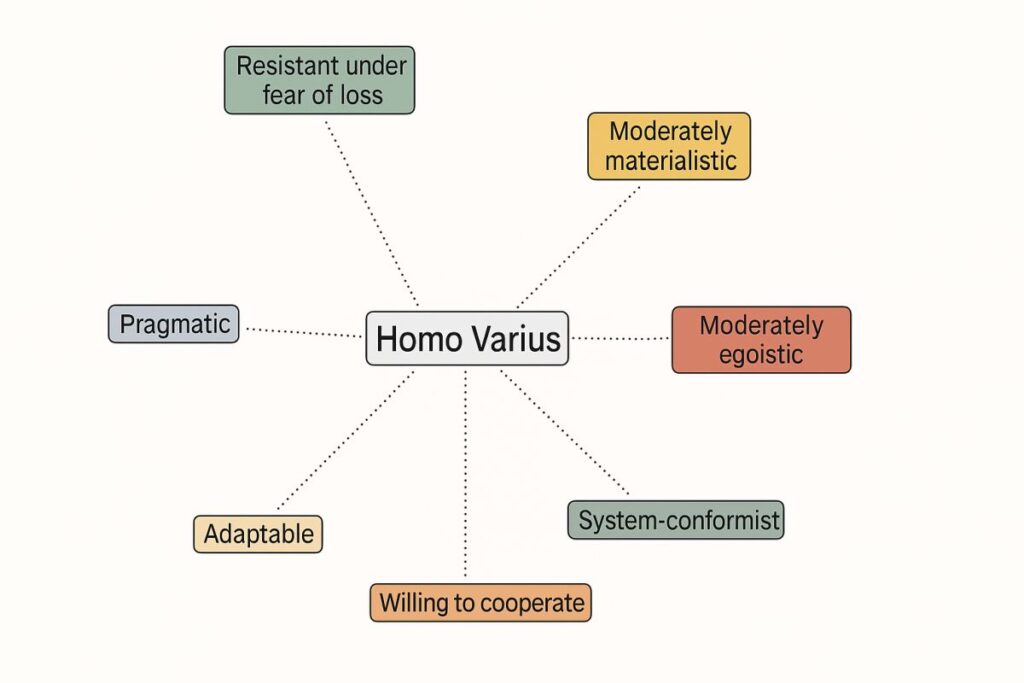
– A bit egoistic and materialistic – especially under existential pressure.
– Willing to cooperate when fairness and reliability are present.
– Pragmatic and adaptable – decides between real options.
– Guided by reason, but also by feelings and impulses.
– Critical when injustice becomes systemic.
– Capable of development – from lone fighter to team player.
Change the system, not the human
Homo Varius shows that humans are not fixed beings but a result of their conditions.
When the economic system spreads fear, egoism and withdrawal arise.
When it creates security and fairness, cooperation grows.
Therefore: We do not need to “change” humans, but the systems that shape them.
- Old human models are too one-sided: humans are rational and emotional.
- Existential security supports cooperation – fear promotes egoism.
- Homo Varius is the guiding concept of BEconomics: diverse, reflective, communal.
© The Economics Coach 2026 (Cover photo: LightfieldStudios/Envato)


Leave a Reply